




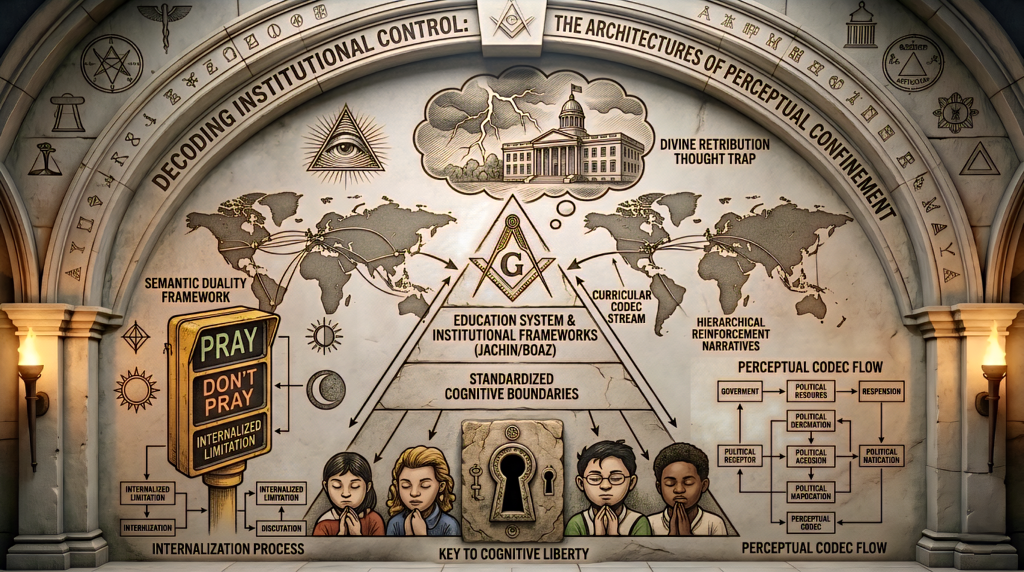
Educational institutions function as architectures of confinement by imposing standardized cognitive boundaries that exclude divergent ontologies. Through the formal curricular framework, human inquiry is restricted to pre-defined parameters, which act as a perceptual codec limiting the scope of possible thought.
Within this system, hierarchical conditioning projects institutional authority as the ultimate arbiter of valid knowledge.

This reinforces a static societal order by establishing a perception of reality that is indispensable from the framework the institution provides. Consequently, the attenuation of critical agency occurs as educational objectives prioritize compliance over autonomous analysis.
This mechanism successfully diverts inquiry away from fundamental structural inequalities and toward models that align consistently with external control architectures.
The confinement is not merely physical; it is a process of internalizing external limitations as free will, ensuring the perpetuation of the existing societal structure by those within it.