



The human body is often conceptualized through the lens of biochemistry, where enzymes, hormones, and proteins drive the machinery of life.
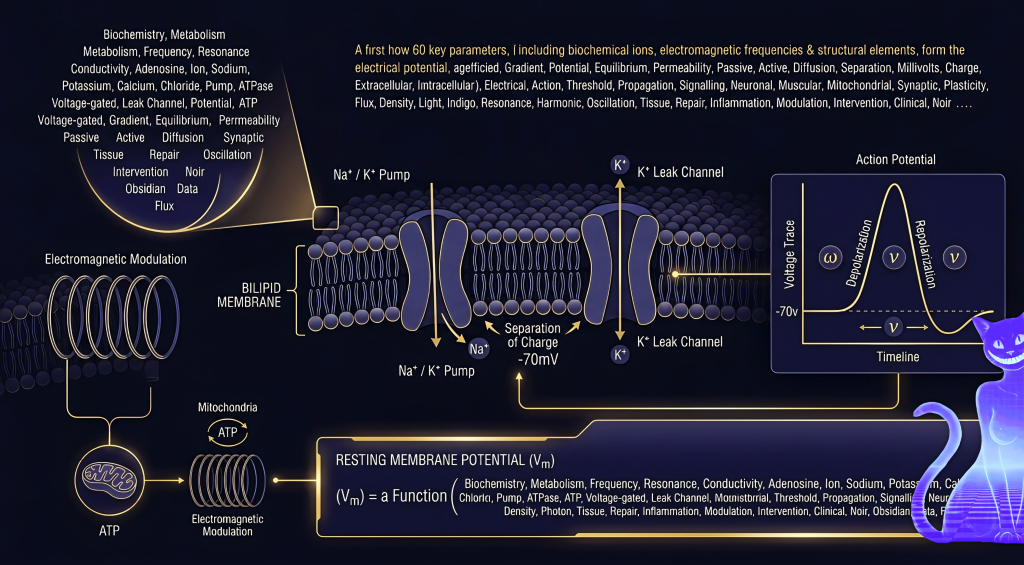
However, this perspective remains incomplete without integrating the fundamental role of electrodynamics. Every cellular process, from the firing of a neuron to the contraction of a muscle fiber, relies on the movement of charged ions across semi-permeable membranes. This establishes an electrochemical gradient that functions as a biological battery, sustaining the voltage required for homeostatic maintenance and cellular signaling.
At the microscopic level, the phospholipid bilayer acts as a dielectric insulator, separating the interior of the cell from the extracellular environment.
The movement of potassium, sodium, and calcium ions creates transient current flows that propagate signals throughout the nervous system.

These electrical impulses are not merely side effects of chemical reactions but are essential conduits for information processing.
When this electrical landscape is disrupted, the body’s regulatory mechanisms falter, leading to systemic dysfunction.
Understanding the body as an integrated electrical circuit allows for a deeper comprehension of how external electromagnetic fields, ranging from near-infrared light to specific magnetic flux densities, can interact with endogenous biological currents.
The field of bio-electromagnetics seeks to map these interactions. It proposes that biological tissues possess unique dielectric properties that determine how they absorb, conduct, or reflect electromagnetic energy. For instance, the resonance of specific protein structures or cellular organelles to external frequencies suggests that the body is not just an isolated system but a participant in a broader electromagnetic environment.
This interaction is the basis for therapeutic techniques like transcutaneous electrical nerve stimulation or pulsed electromagnetic field therapy, which utilize targeted inputs to restore or modulate the electrical balance within damaged tissue.
As research advances, the potential for precision intervention grows. By treating the body as an electro-conductive architecture, it becomes possible to design technologies that operate at the same frequency as biological processes, minimizing invasive procedures and maximizing endogenous repair. The future of medical science may reside in the refinement of these non-invasive, frequency-based interventions, shifting the paradigm from chemical suppression to electrical regulation. Integrating these insights requires a shift in how biological data is collected and analyzed, prioritizing the mapping of charge flow and field distribution over simple molecular concentration. This transition to an electro-centric model of human health represents a fundamental evolution in our ability to interface with, and support, the underlying mechanics of biological existence.