




The persistence of biological structure against the inexorable pull of thermodynamic equilibrium remains one of the most profound inquiries in modern science. At the foundational level, living systems are far-from-equilibrium structures that maintain their internal order by accelerating the production of entropy in their surroundings. This process is governed by the second law of thermodynamics, which dictates that energy and matter naturally transition from states of low entropy to states of high entropy. When an organism ceases to function, the maintenance of this non-equilibrium state fails, triggering a cascade of degradation known as autolysis.
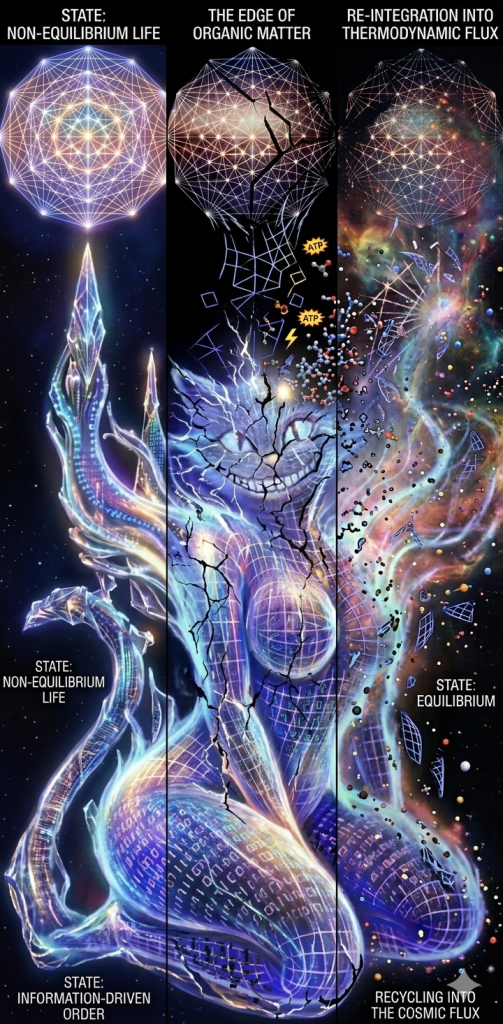
Autolysis is an active, orderly process of self-disassembly where endogenous enzymes initiate the breakdown of cellular components. As cellular homeostasis collapses, the depletion of energy carriers triggers an internal crisis that halts membrane-stabilizing pumps, leading to a catastrophic influx of ions and the subsequent activation of degradative enzymes. This transition is not merely the destruction of material, but the liberation of potential energy as highly organized molecular structures are recycled into simpler, disordered forms.
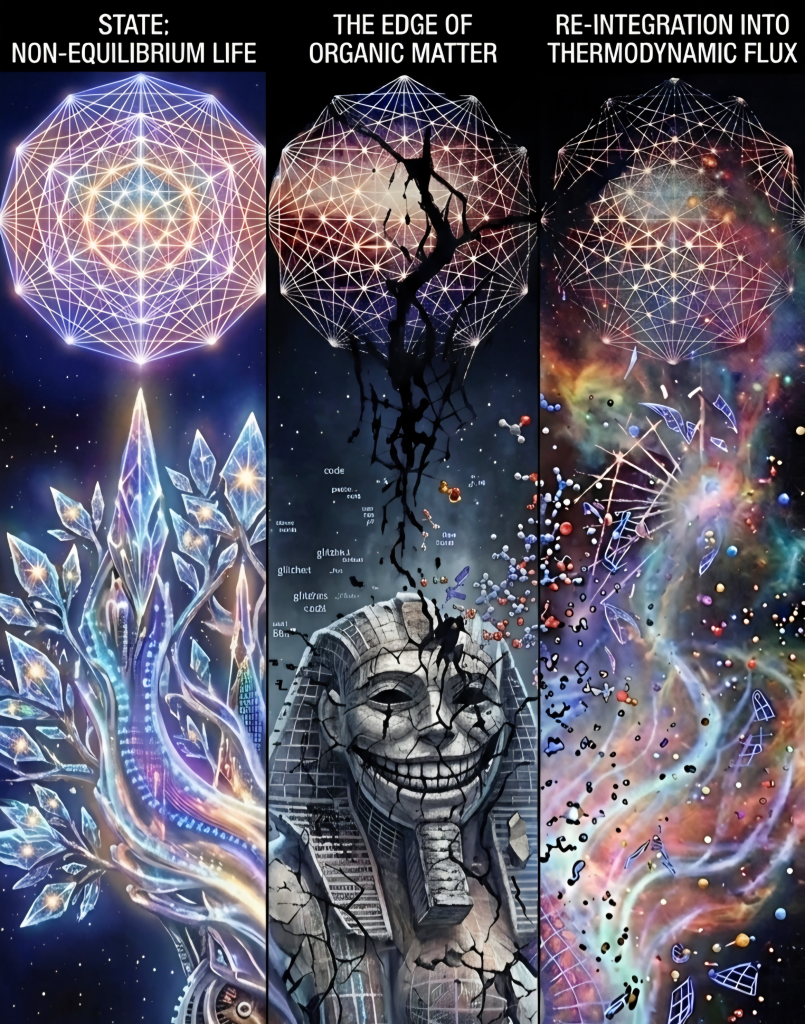
From an informational perspective, biological life can be defined by the causal efficacy of information over the matter in which it is instantiated. In this framework, the transition from life to non-life is a shift in causal architecture; when the information-processing mechanisms that define a biological entity dissolve, matter loses its context-dependent organization.
Consequently, the study of organic matter decay reveals a fundamental interplay between energy dissipation, the breakdown of structural complexity, and the eventual re-integration of matter into the wider thermodynamic flux of the universe.